
Executive Dossier
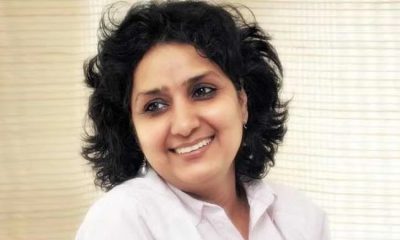
‘A writer needs powers of observation and sensitivity’ : Vinta Nanda


Vinta Nanda started out as an assistant to Raman Kumar on the unforgettable Yeh Jo Hai Zindagi. As assistant director, she was actively involved on the screenplay of the serial. For several years thereafter, Nanda directed documentaries highlighting social concerns until Tara happened.
Tara, which was bold and path-breaking, has left an indelible mark on Indian television. But its huge success also incurred the wrath of critics who accused her of writing degenerative stuff- allegations that Nanda strongly refutes.
Zee’s re-launch last month also saw Nanda bounce back with two new serials – Sansaar and Deewane to Deewane Hai, both of which are trendsetters again if one takes into account the scale on which these serials have been planned and shot. Sansaar will rank as the first serial that has a story spread across five continents and which is actually shot in all the five continents. Spurred by the success of these two serials, Nanda is writing two more serials that will take off shortly.
Nanda took time off from her hectic schedule to speak to www.indiantelevision.com’s correspondent, Amar. Excerpts:
What brought you into TV writing?
Well, creativity, imaginativeness and a flair for writing were there in me from the very start. I wrote my first play in school when I was all of 8 years old. After graduation from Chandigarh, I came to Mumbai to become a journalist. But while I was training to be a journalist, I joined Frank Simone Advertising in their production department and took an instant liking for the medium. Thereafter I started assisting Raman Kumar on Yeh JO Hai Zindagi. As Raman Kumar’s whole approach is writer-driven, I first started writing for YJHZ. My first independent project as writer was Tara.

What are the natural instincts required to be a successful writer?
Power of observation and sensitivity. The rest is the application of these two instincts into any given idea.
Where do you draw your inspiration from?
It would be difficult to pinpoint any particular source. I would say I draw my inspiration from my experiences in life. For instance, the idea of Tara came from my own initial days of struggle in Mumbai. The motivation of course comes from the faith that people of the caliber of Mahesh Bhatt (for the Plus Channel produced Kabhi Kabhi) and Raman Kumar have bestowed upon me.
 Aditya Hitkari as ‘Vicky’ with co-actor in Deewane To Deewane Hai aired on Zee |
‘I don’t feel totally alienated from any of the characters that I’ve created. Most of these characters have some traces of me in them.’
|
Outline the whole process from the stage you conceive a project to the stage when the final script is complete.
It all begins as a one-line thought or concept. Thereafter it is drafted as a one-page story and submitted to the channel. Once the channel gives its nod, I start developing the characters in depth. Then all characters are woven into the story I had in mind. I the
develop the story for 250 episodes before we start shooting. The dialogues for a given number of episodes are written from time to time.
What do you do as a series writer?
See, when I’m developing four or five concepts or stories simultaneously, it is not possible for me to be personally involved with the dialogues and other intricacies of every scene. I do decide from where to where the story is going to move in each episode and work on the screenplay. But beyond that, the dialogue writers do the needful.
Do you identify with any of the characters that you’ve created?
Yeah. Let me put it this way. I don’t feel totally alienated from any of the characters that I’ve created. Most of these characters have some traces of me in them. I’ve identified in a way with “Tara”. I identify with the “Rahul” of Deewane To Deewane Hai. Like me when I was his age, he aspires, has dreams, knows his goals and knows how to achieve them. The fact that we are of the opposite sex hardly makes any difference.
Do real life incidents play a role in your writing?
Oh yes, they do. A couple of years back, on one of my visits to New York, I met an Indian victim of a hit and run case who was in hospital with all of 49 broken bones. When I met him ten months later, when he had almost recovered, the doctor told me he was surprised a patient in such bad shape and having to undergo such a prolonged course of treatment did not need a psychiatrist. But do you know why he didn’t require a psychiatrist? It was because his family could do what the psychiatrist could not. His mother who was in India and both his brothers’ wives who were in the U.K. were selfless enough to leave their work to be with him. This bond which is so peculiar among Indians even when they are physically existing in entirely different parts of the world is what forms the theme and driving force behind the story of Sansaar.
|
‘It is the traditional regression that is shown today, the make-believe joint family dramas. What you see
is the convolution of creativity.’ |
 |
Even though Tara was a huge hit, it drew some flak for the degenerative portrayal of women? Comment on your responsibilities as a writer towards people’s sensibilities.
How can you possibly accuse me of offending people’s sensibilities with Tara? If anything offends their sensibilities, it is the traditional regression that is shown today, the make-believe joint family dramas. What you see today is the convolution of creativity. Tara, on the contrary was the story of an ambitious, progressive and courageous woman, who was independent, wanted to break free from the dregs of hypocritical society and who did not need a man for her dependence. Has Tara, or for that matter any of my serials, harped on extramarital affairs? I fail to see any reason why I should be accused of writing something degenerative.
 A scene from Sansaar aired on Zee A scene from Sansaar aired on Zee |
‘Writing just requires an urge and the right frame of mindly.‘
|
Is being writer-director of the same project beneficial or harmful?
Personally, I don’t write the projects I direct and vice-versa. It is a policy decision that Raman and I have taken. He directs the projects written by me and I direct the projects written by him. This is because we feel that having a second person’s opinion minimises the scope for error.
What kind of a writing schedule do you normally follow?
I am quite indisciplined as far as my schedule goes. I write once in the day – that could be in the morning, afternoon or evening for a few hours.
Does writing require isolation from people in order to concentrate?
Not really. It just requires an urge and the right frame of mind. I have even written on the sets.
Do you write in English or Hindi?
Mostly in English, sometimes it’s a mix of English and Hindi. The language is just the dressing on the cake. As long as the ideas come across in a powerful manner, the language does not matter so much.
Doesn’t TV writing tend to get clichéd and monotonous? Vipul D. Shah has said in his interview that TV writing is hardly inspiring because what is shown in the 20th episode can be repeated in the 25th episode with some minor changes.
I have never approached TV writing so dispassionately. That would amount to taking the audience for a ride. My documentaries have required me to travel extensively across the country and I’ve been struck by the amazing levels of intelligence and creativity possessed by our people living in the smaller towns of the country. We need to respect this intelligence of our audience. All the projects I have written have been written with utmost passion and commitment.
Are you hassled by the executive producers in channels to change your storyline from time to time?
No, not at all. We have an excellent working relationship with Zee TV. Right at the time the serial gets approved, we are given a team of executive producers for our show. Every decision that we take, be it on the storyline or any other aspect, is worked in tandem with them. Sometimes, I even accept their ideas and reject what I myself had originally thought because after all they know better what sells for the channel and what doesn’t.
|
The subjects that I would like to dwell on are the status of women in our society, what role religion plays in their exploitation, status of law and human rights, the tragedy resulting out of the criminalisation of society.
|
 |
But what is the secret of this beautiful relationship you have with Zee when most producers have fallen out with the channel at some point of time or the other?
If you ask me, I feel the producers have not been able to deliver on Zee’s quality demands. See, Zee is totally content driven as against other channels which depend heavily on their packaging or dressing. If we enjoy such a good relationship with Zee, it is due to the fact that our content as far as the story goes has been very strong.
Are enough story lines/ concepts being tackled today or have we reached a dead end?
No, we can never reach a dead end as far as TV goes. Yes, there are trends which tend to dominate and overshadow everything else. That I guess was the case till about a month back but Zee’s new programmes have brought about a refreshing change.
Which are the subjects closest to you at the moment?
See, all these years, I have continued to make documentaries on issues of social concern and it is these concerns that are closest to me at the moment. The subjects that I would like to dwell on are the status of women in our society, what role religion plays in their exploitation, status of law and human rights, the tragedy resulting out of the criminalisation of society. In fact, Sazaa, a movie I am directing, has a similar offbeat theme. It revolves around the plight of a 30-year-old virgin widow who was married at the age of six and became a widow at the age of eight.
Which has the happiest moment of your career?
Mahesh Bhatt calling me up to tell me that I was directing a movie which is being produced jointly by Vishesh Films and PNC (Pritish Nandy Communications). It was like my most cherished dream coming true.



Executive Dossier
Game on, fame on as Good Game hunts India’s first global gaming star
New reality show puts Rs 1 crore prize and global spotlight on India’s gaming talent.

MUMBAI: Game faces on, pressure high India’s gaming ambitions are levelling up. Good Game, billed as the world’s first as-live global gaming reality show, has officially launched in India with a bold mission: to crown the country’s first Global Gaming Superstar.
Blending esports with mainstream entertainment, the show brings together competitive gaming, creativity and on-camera performance in a format that tests more than just joystick skills. Contestants will be judged on gameplay, screen presence and their ability to perform under pressure, reflecting how gaming has evolved from pastime to profession and pop culture currency.
Fronting the show are three high-profile ambassadors: actor and entrepreneur Samantha Ruth Prabhu, Indian cricket star Rishabh Pant, and gaming creator Ujjwal Chaurasia. The winner will take home Rs 1 crore ($100,000) among the largest prize pools for any Indian reality show along with the chance to represent India on a global stage.
Backed by a planned annual investment of up to Rs 100 crore, Good Game is also courting brand partners, promising a minimum reach of 500 million among India’s core youth audience. The creators position the show as a bridge between entertainment and interactive culture, offering long-format content, community engagement and commercial scale.
Auditions are now open to Indian citizens aged 18 and above, inviting amateur and professional gamers, creators and performers alike. Shortlisted candidates will be called for in-person auditions in Mumbai on 14 and 15 February, and in Delhi on 28 February and 1 March 2026.
With big money, big names and even bigger ambition, Good Game signals a shift in how India views gaming not just as play, but as performance, profession and prime-time spectacle.
Digital
SpotDraft hires new CMO and CFO to fuel global push for its AI contract platform
Alon Waks and Amit Sharma join as SpotDraft accelerates growth across key markets

INDIA: SpotDraft has strengthened its senior ranks as it gears up for faster global expansion, naming Alon Waks as chief marketing officer and Amit Sharma as chief financial officer. The appointments follow the firm’s $54 million Series B round earlier this year and mark a push to scale across the Americas, EMEA and India.
The AI-powered contract-lifecycle-management platform has posted 100 per cent year-on-year growth in customer acquisition, counting Apollo.io, IPSY, Mixpanel, Oyster and Panasonic among its global clients. The firm processes more than one million contracts annually, with volumes up 173 per cent and nearly 50,000 monthly active users.
Waks, a veteran of Kustomer, Bizzabo, CreatorIQ, LivePerson and ZoomInfo, will steer global marketing and category positioning as legal teams adopt AI-driven tools. Sharma, who has led finance across scaling tech firms since 2016, will guide financial strategy, investor relations and market expansion.
Both hires aim to sharpen SpotDraft’s bid for a larger slice of the fast-growing legal-tech market, expected to exceed $63 billion by 2032. Co-founder and chief executive Shashank Bijapur said the company is focused on scaling go-to-market operations in the Americas, deepening leadership in EMEA, and accelerating AI capabilities for general counsels and legal-operations leaders.
Clients report shorter deal cycles and better alignment between legal and business teams. “What used to take weeks now happens in days,” said Abnormal Security senior legal operations manager Susan Koenig. DeepL head of legal operations André Barrow, said SpotDraft has helped reframe legal “from a cost centre to a generator of revenue”.
Executive Dossier
Outdoor Ads Get Smarter as LOC8 Shifts OOH from Visibility to Attention
AI, dwell time and real-world vision are rewriting the rules of what outdoor ads can do.

MUMBAI: Out-of-home ads were once the wallflowers of marketing seen by everyone, noticed by few. But in an age where attention has become the world’s most fought-over currency, even billboards are getting a brain upgrade. Enter LOC8, OSMO’s AI-powered attention engine, quietly reshaping the old OOH playbook by measuring not just who could have looked at an ad, but who actually did. The shift is subtle but seismic: impressions are out, impact is in and data, not gut instinct, is calling the shots.
In a landscape where marketers question every rupee spent outdoors, LOC8 is turning lampposts, flyovers and traffic islands into precision-mapped attention laboratories. By crunching dwell time, visibility zones, perceptual size and real-world obstructions, the platform is dragging OOH into a future where creativity meets computer vision and where the best ideas aren’t just eye-catching, but eye-measured. From automotive facelifts to FMCG novelty and real estate trust-building, the message is clear, outdoor has stopped shouting and started listening. Indian Television Dot Com explores more about it in an Interview interview with OSMO co-founder Nipun Arora.
On how OSMO is shifting outdoor advertising from a visibility-led medium to an attention-led one through LOC8.
Traditional OOH has long been measured by visibility and impressions i.e how many people could see an ad. OSMO, through its proprietary AI platform LOC8, is shifting that narrative more towards likelihood of being noticed. Using computer vision and machine learning, LOC8 analyzes real-world video data to measure visibility zones, obstructions, dwell time and perceptual size; bringing precision to how attention is quantified outdoors. It moves the focus from mere impressions to quality of impressions, making OOH a data-verified, attention-led medium comparable to digital in accountability.
On how marketers can use LOC8’s dwell-time, visibility and perception insights to craft more effective, emotionally resonant OOH campaigns.
LOC8 helps brands understand how people truly experience outdoor media how long they look, from what distance, and under what conditions. By quantifying dwell time, visibility duration, and perceptual size; marketers can plan campaigns that align with real human viewing behavior. This empowers creative and strategy teams to design emotionally resonant storytelling where messaging, visual hierarchy and placement are optimized for how people actually notice and process OOH creatives.
About what LOC8 has revealed through campaigns like Renault Triber and Namaste India on how categories such as auto, FMCG and real estate use attention metrics to drive outcomes.
Each category uses attention data differently but all share one common goal: to convert outdoor visibility into measurable engagement.
• Automotive | Renault Triber
For the new Renault Triber facelift, bold creative met data-led planning through LOC8. By analyzing on-ground video data, LOC8 measured real audience attention across placements factoring in visibility zones, obstructions, traffic speed and perceptual size. This enabled Renault to identify corridors that delivered maximum reach, saliency and engagement, optimizing media efficiency and ROI.
• FMCG | Namaste India
In OOH, innovation is the hook and assets are the bait. But bait often hides the hook. With Loc8’s attention metrics, we ensured the bait wasn’t a hurdle, rather it became the perfect stage for innovation to deliver its full impact! The insight proved that creative novelty, when validated by attention data, drives deeper engagement and measurable brand lift.
• Real Estate
For luxury and real estate campaigns targeting HNI/UHNI audiences, attention patterns differ especially between front and rear passengers, who are often the core audience segment for premium sites. LOC8’s ability to distinguish rear vs. front visibility plays a critical role here. It helps identify sites that offer longer viewing windows and stronger perceptual dominance from the rear seat where decision-makers are most likely seated making it a key differentiator for premium and trust-led categories. Together, these insights prove that auto optimizes for impact, FMCG for recall, and real estate for trust visibility showing how attention metrics adapt to category goals while ensuring measurable outcomes.
On how attention analytics will shape the future of brand storytelling and media planning as OOH becomes more digitised and data-driven.
As outdoor digitizes, attention analytics will inform not just where to advertise but how stories are told in public spaces. This evolution transforms OOH from a static broadcast channel into a dynamic attention ecosystem, where creativity is optimized through evidence-based insight.
On how LOC8’s data-led framework helps marketers quantify OOH impact and make outdoor a more accountable, ROI-driven medium.
LOC8 bridges the gap between intuition and evidence. By quantifying metrics like visibility duration, attention opportunity index, and visual saliency rank, it allows brands to benchmark site performance and justify investment. This data-led approach brings transparency, comparability and ROI measurement to a medium historically driven by perception.
On how OSMO ensures AI and computer vision enhance creativity rather than reduce it to numbers.
OSMO believes that technology should enhance creativity, not overshadow it. LOC8’s attention models reveal what naturally draws the human eye helping creative teams refine design cues, contrast, and visual hierarchy for greater impact. By merging art and science, LOC8 empowers creativity with intelligence.
About the creative best practices and design cues LOC8 has uncovered regarding what truly captures consumer attention outdoors.
LOC8’s visual cognition analysis has surfaced clear patterns across campaigns:
• High contrast and minimal messaging outperform cluttered designs.
• Motion cues draw significantly longer dwell times.
• The first two seconds are critical, creatives must establish focus instantly.
• Contextual alignment between the creative and its environment increases attention by over 30%.
These learnings offer a scientific foundation for creative effectiveness helping brands design OOH that’s visually magnetic and emotionally memorable.
On how attention metrics will integrate into omnichannel planning where OOH, digital and social work together for unified brand impact.
Attention can become the unifying KPI across OOH, digital and social to creates seamless storytelling continuity, where outdoor triggers digital engagement. The future of omnichannel planning lies in attention-led integration ensuring that campaigns don’t just reach audiences everywhere but truly capture and hold their focus.

TEST
TEST


MIB sets OTT accessibility rules, mandates captions and audio description
Platforms get three years to add features for hearing and visually impaired


Boney Kapoor acquires remake rights of Tamil political satire Thalaivar Thambi Thalaimaiyil
Strong word-of-mouth turns Pongal satire into remake pick


Netflix India names Rekha Rane director of films and series marketing
Streaming giant bets on a seasoned marketer who helped build Amazon and Netflix into household names


Zabeen signs off from TV9 after shaping the network’s public voice
Communications leader exits after three years spanning MD office strategy and media outreach.


Dhawan steps up to bat for Delhi’s grassroots sports push
Cricket star named face of Delhi Khel Mahakumbh to fuel youth talent hunt.


Orient Beverages pops the fizz with steady Q3 gains and rising profits
Kolkata-based beverage maker reports stronger revenues and profits for December quarter.


Cheekatilo shines in the dark with record debut on Prime Video
A crime thriller steps out of the shadows as Telugu storytelling claims centre stage.

Checkmate Goes Digital as Chess Joins Esports Nations Cup 2026
From boards to bytes, chess readies for a nation-first showdown in Riyadh.


Washington Post CEO exits abruptly after newsroom cuts spark backlash
Leadership change follows layoffs, protests and a bruising battle over trust.


BCCL profit jumps 53 per cent in FY25 as tax bill shrinks
Revenue rises 4.3 per cent to Rs 10,209.33 crore while deferred tax gain lifts bottom line sharply


Zee Cine Awards 2026 set for fan-first celebration in Mumbai
Akshay Kumar and stars launch awards at NSCI Dome on Feb 28


JioStar absorbs IndiaCast to streamline distribution
Merger creates one-stop hub for content, digital, and delivery


Hamdard honours changemakers at Abdul Hameed awards
NEW DELHI: Hamdard Laboratories gathered a cross-section of India’s achievers in New Delhi on Friday, handing out the Hakeem Abdul...


Why the best campaigns today start with insights, not ideas
MUMBAI: For decades, creative storytelling has been the cornerstone of brand communication. The “big idea” amplified through catchy jingles, striking...
-
I&B Ministry4 months ago
MIB sets OTT accessibility rules, mandates captions and audio description
-

 News Headline5 months ago
From selfies to big bucks, India’s influencer economy explodes in 2025
-

 e-commerce5 months ago
Swiggy Instamart’s GOV surges 103 per cent year on year to Rs 7,938 crore
-
 MAM2 years ago
OpenAI joins C2PA steering committee
-
 Digital10 months ago
Squadstack AI helps Stage cut calls by 55 per cent and costs by 70 per cent
-
 News Headline1 year ago
TRAI puts a ‘stop’ to unsolicited calls and messages
-
 iWorld1 year ago
Kuku TV transforms India’s OTT space with vertical microdrama boom
-

 Brands4 months ago
Page Industries posts steady Q3 growth, declares Rs 125 interim dividend