
DTH
Zee goes into HITS, DTH overdrive

NEW DELHI: Since 29 May, the smile on Jawahar Goel’s face has broadened and the additional vice-chairman of the Subhash Chandra-promoted Zee Telefilms just cannot hide his excitement. Sitting in a second floor room of a yet-to-be-given-finishing-touches building in Noida, on the outskirts of Delhi, which houses Zee’s state-of-the art facility for headend in the sky (HITS) project for CAS as also the proposed DTH service, Goel gleefully rubs his hands and quips, “Ab aayega mazaa (the excitement will begin now).”

He has reasons to feel elated. A strong supporter of conditional access system, which aims to bring addressability in Indian cable homes from 14 July, 2003, Zee and some other Chandra companies have got a shot in the arm with the Indian government’s announcement yesterday that there would be a hefty reduction in the customs duty on import of set-top boxes, albeit only till 31 July.
The move, explains Goel, is like giving an assurance to all those who have been supporting the government move on CAS and would also help them in executing their business plans with a larger degree of confidence. Not only did Goel, heading Zee’s cable arm SitiCable, through which the HITS project is being sought to be implemented, immediately say that the benefits would be passed on to the cable consumer in the wake of the customs duty reduction, but it also washed away part of his cautious optimism, which was evident when he had invited indiantelevision.com to visit the swanky HITS and DTH facility.
At that time, not sure whether CAS would become a reality or not because of stiff political and other resistance, Goel had lamented, “Just because there is rivalry amongst players in the industry, a postponement of the CAS implementation deadline is being sought. But I think such moves may be detrimental as this was a chance to bring some semblance of order into an industry that we ourselves call chaotic.”

“We are ready to go live with HITS from the D-day and follow it up with the DTH service” ASC Enterprise chief executive Puneet Goenka But Goel’s optimism stems from the fact that Zee and some sister companies have been quietly working towards a time when the whole set up would be ready to implement the government-mandated CAS and also start a KU-band DTH service piping nearest rival Space TV/Star to the post.
Some Rs 4,000 million has been invested by the various Chandra companies in the HITS and DTH facility, which is close to being commissioned. The equipment from companies like Textronics, Phillips and Sony are in place, transponders on Insat have been leased, the array of TV monitors are flickering for a demo and the wooing of cable ops for partnership for HITS (marketed under brand name Galaxzee) is in full swing.
“In short, we are ready to go live with HITS from the D-day and follow it up with the DTH service,” explains chief executive Puneet Goenka of another Chandra-promoted company, ASC Enterprise (the licence holder for uplinking channels for DTH and HITS), as he takes one around for a guided tour of the facility.
For India’s biggest vertically integrated media company, Zee Telefilms, the circle seems to be close to getting completed on HITS, DTH.

The equipment landed in India around 21 April and in three weeks time the facility was put together. Not satisfied with 3 C band and 4 KU band transponders on Insat 3A satellite, Zee-ASC has requested for more KU-band transponders, which, Goel says, are likely to come through soon The additional KU-band transponders would be needed for the DTH service where Chandra’s companies are seeking to provide between 48 to 60 TV channels in the first phase, plus 12 satellite radio channels. What’s more, the glitzy facility at Noida also has the total capacity to play out 40 channels on a deferred basis.
Explains Goenka, “We have 10 Flexicarts (each of them can playout two channels) and some more would arrive soon. At the heart of the whole system is the Drake Automation, which helps in monitoring the whole process.” The whole system does look impressive as a set of three TV monitors help in monitoring the progress and quality of the audio-video feed in three stages till the time the feed enters a consumer’s home and is played out through a set-top box.
The first stage involves downlinking of channels at the HITS facility, the second stage is when the encrypted channels are turned around or uplinked again to a satellite to be beamed back to earth and the third stage involves the feed being redistributed to the consumers by the cable service provider (MSOs and cable ops). “At each stage the quality of the audio and video feed is closely monitored for corrections to be made,” points out Goenka, and if there is even a minute’s lapse it surfaces. For example, if a signal at any stage does not have the audio for 10 seconds, alarm bells start ringing and the fault is immediately rectified.
Chandra’s men are better prepared than competition where CAS and DTH are concerned.
So, when would the test signals for the HITS and DTH projects start? Ideally Goel would have already started with the test signals, but with controversy around CAS implementation hotting up, he was playing the wait and watch game from the sidelines. “If all sorts of developments had not clouded the CAS rollout in recent days, we would have started the KU-band test signals from 27-28 May itself,” he says as he punches some keys on his Nokia Communicator to access an important e-mail, probably sent from a vendor of the set top boxes in one of the South East Asian countries.
Knowing fully well that if they cannot deliver this time round, they would not be able to deliver for a long time to come, Goel also has reinforced the team that would lead the charge of the light brigade. Puneet Goenka, who would also oversee the DTH operations, would now spend more time in Delhi than in Mumbai where ASC Enterprise is headquartered and the marketing and distribution team of Siti Cable have been told to be in constant touch with him and Zee Turner CEO Sunil Khanna, another important link in the whole chain.

Even while this piece is being written, probably the first shipment of STBs may be on its way from South Korea carrying a load of about 50,000-odd boxes that would start to get seeded in the market from mid-June. Pointing out that in about five months time they expect to bring in 2 million boxes. Goel said, “If everything goes as planned, the first lot of the boxes would be in the market by 15 June (almost a month ahead of the CAS rollout deadline)”. Some 13-odd manufacturers in South East Asian countries, according to Goel have been contacted for the boxes. The CAS software, of course, is being sourced from the Europe-based Conax under a multi-million dollar deal, while the subscriber management system would be partly put together by Cyquator.
The lucidity with which Goel reels off facts probably also goes to show that this time round Chandra’s men are better prepared than competition where CAS and DTH are concerned. For India’s biggest vertically integrated media company, Zee Telefilms, the circle seems to be close to getting completed. Unless some last minutes hitches crop up like other broadcasters like Star and Sony refusing to be part of a Zee-sponsored HITS platform. But that is something that has already been factored into the plans.





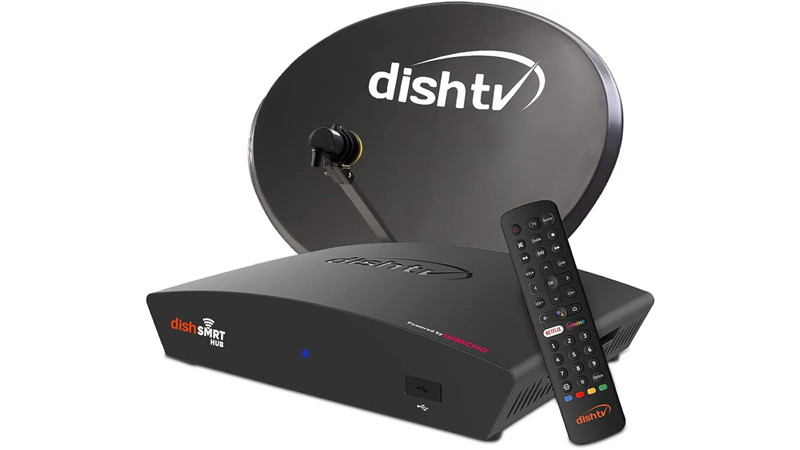
NOIDA: When the remote stops working, you don’t throw it away, you change the batteries. Dish TV is trying something similar. Faced with falling subscription revenues and a fast-shrinking DTH universe, India’s once-dominant satellite broadcaster is flipping channels, betting on smart TVs, OTT aggregation and a hybrid future even as the numbers flash red.
For the quarter ended 31 December, 2025, Dish TV India reported operating revenues of Rs 2,991 million, down 19.8 per cent year-on-year from Rs 3,730 million. Subscription revenues, still the backbone of the business, fell sharply by 32.2 per cent to Rs 2,245 million, reflecting industry-wide cord-cutting and persistent churn. The pain shows up clearly below the line.
Ebitda swung to a loss of Rs 415 million, compared with a profit of Rs 1,227 million a year earlier. Total expenditure climbed 36.1 per cent to Rs 3,406 million, pushing costs to nearly 114 per cent of operating revenues. The quarter closed with a loss before tax of Rs 2,762 million, weighed down further by exceptional items of Rs 700 million. Yet the company insists this is not a business stuck buffering, but one deliberately loading a new format.
Dish TV is repositioning itself from a pure DTH operator into what it calls a connected-home entertainment platform, stitching together live television, OTT apps and smart devices. The centrepiece of that strategy is the nationwide rollout of VZY smart TVs, offering a unified DTH-plus-OTT experience.
Amazon Prime Video has now been integrated across Dish TV’s ecosystem, including Watcho and VZY. Watcho, the company’s in-house OTT super app, has crossed millions of downloads and paid subscribers, aggregating more than 25 content apps.

Fliqs, its creator-driven content platform, is being pitched as a home for premium regional and international programming. Brand visibility has also been boosted through splashy partnerships with Bigg Boss Hindi and Bigg Boss Kannada: high-decibel bets in a crowded attention economy.
“Indian home entertainment is undergoing a structural shift,” said CEO and executive director Manoj Dobhal arguing that Dish TV’s hybrid model improves convenience while keeping customers within a single ecosystem. The revenue mix shows early signs of diversification, even if it is not yet compensating for falling subscriptions.
Marketing and promotional fees rose 27.3 per cent to Rs 399 million, while advertisement income, still small, nearly doubled to Rs 48 million. Other operating income surged 267.6 per cent to Rs 298 million, softening the overall revenue decline.
On costs, the company is tightening the screws. It has renegotiated transponder contracts, rationalised call-centre and general expenses, and improved asset discipline by boosting set-top box recovery beyond 30 days, reducing swap frequency and replacement capex.
New customer activations are being driven through a no-subsidy Rs 999 set-top box, a move management says materially improves unit economics and cash flow. Still, risks remain stubbornly in view. Churn continues to shadow the business, and scaling Watcho while balancing content spend will demand execution discipline.
Cost cuts, the company admits, must not erode service quality: a delicate act in a market where customer loyalty is already thin. For now, Dish TV’s numbers tell a story of strain.
DTH
Tata Play deepens Odia push with ad-free ‘Odia Manoranjan’ platform
Powered by Sidharth TV, the Rs 2-a-day service bundles films, Jatras, shows, and much more

MUMBAI: Tata Play is doubling down on regional loyalty. India’s leading DTH player has launched Tata Play Odia Manoranjan, a new value-added service that corrals Odia entertainment into a single, ad-free destination, available on television and the Tata Play mobile app.
Powered by Sidharth TV, one of Odisha’s most popular Odia-language GECs, the platform serves up a hefty catalogue: over 180 movies, 100+ Jatras, around 20 television shows and a library of more than 12,000 songs spanning devotional, folk, film and non-film genres. From vintage favourites to contemporary titles, the mix is pitched squarely at Odia-speaking households, with particular pull in tier-3 and tier-4 markets.
Subscribers get 24×7, full-screen SD viewing without ad breaks on channel number 1755, with live TV and VOD access across screens. The price point is deliberately sharp: Rs 2 a day.
Pallavi Puri, chief commercial and content officer at Tata Play, framed the move as a bet on language and culture. “India’s strongest viewing loyalties are rooted in language and lived culture. Tata Play Odia Manoranjan brings together the many expressions of Odia entertainment—from films and Jatras to devotional programming and music—into one clearly defined destination. With this launch, Tata Play further elevates its regional content offering by giving Odia audiences a single, definitive home for their stories and traditions.”
For Sidharth TV Network, the partnership is about reach without compromise. Sitaram Agrawalla, owner and chairman, said: “For decades, Odia families have trusted our entertainment platforms for stories that feel like home, and for moments that bring us together. Tata Play Odia Manoranjan builds on this trust by placing a diverse range of Odia films, theatre, devotional music and shows into a single, accessible space. This collaboration isn’t just about wider distribution—it’s about honouring the preferences of Odia viewers with a seamless, ad-free viewing experience that reflects their language, culture and the way they choose to engage with content.”
The new service slots into Tata Play’s expanding portfolio of entertainment and infotainment platform services across genres including entertainment, kids, learning, regional and devotion, catering to all age groups.
In short: one language, one screen, zero ads—and a clear signal that regional is where the real viewing power lies.
DTH
Binge strikes play as Tata Play adds Times Play to its OTT universe
Tata Play Binge expands its streaming galaxy plus adds Times Play’s movies, series and live TV.
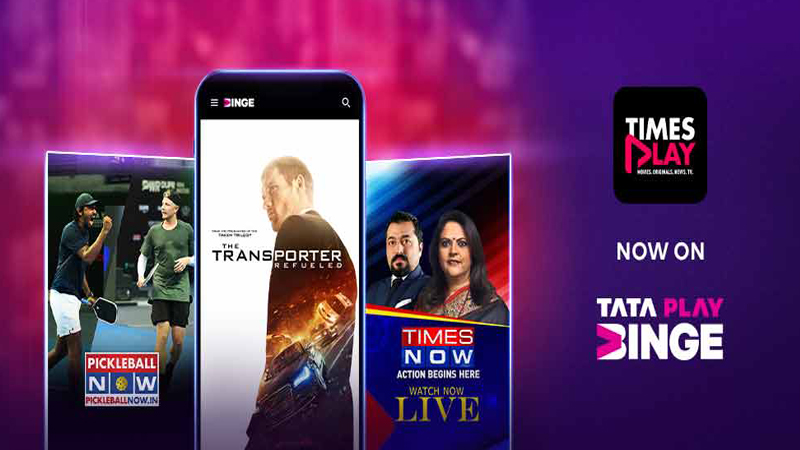
MUMBAI: If streaming had galaxies, Tata Play Binge just opened a wormhole. In its latest move to become India’s most sprawling entertainment universe, the platform has now folded Times Play, Times Network’s digital-first OTT service, into its all-in-one subscription bouquet bringing Hollywood hits, snackable shorts, live news, lifestyle, entertainment, Pickleball and 11 live TV channels under a single roof.
The new addition means subscribers no longer need to hop between apps in Olympic-level finger gymnastics, Binge now pulls Times Network’s entire digital catalogue into one screen, one login, one bill. And in the era of attention overload, that’s practically a public service.
Times Play brings with it a distinctive blend of premium Hollywood cinema, web series, short-format videos, and Times Network’s formidable news muscle. Viewers can flip seamlessly between Romedy Now, Movies Now, MNX, MN+, Zoom, Times Now, Times Now Navbharat, ET Now, ET Now Swadesh, and even Pickleball Now, mirroring the growing Indian appetite for niche sporting entertainment.
On the long-form front, hits like Reunion, India’s Story, True Story of Angeline Jolie, Orphan First Kill, The November Man, Barely Lethal, Southpaw, The Hurt Locker, Transporter Refueled, and The Holiday sit alongside Times Network factual and current-affairs staples including Frankly Speaking, Sawaal Public Ka, and News Ki Paathshaala.
Describing the partnership, Tata Play chief commercial and content officer Pallavi Puri, said the aim remained unchanged to make content discovery effortless and reduce the modern curse of app overload. She noted that integrating Times Play enriches Binge’s already deep catalogue with a broader mix of premium films, originals and news programming “without juggling multiple apps or subscriptions”.
Times Network echoed the sentiment, calling the collaboration a natural extension of its mission to deliver credible entertainment and journalism at scale. It emphasised Tata Play’s reach, reliability and reputation as a key driver in bringing Times Play’s digital catalogue to diverse Indian households.
With the addition of Times Play, Tata Play Binge now boasts 30 plus OTT platforms on a single interface, a list that includes Prime Video, JioHotstar, Zee5, Apple TV+, Lionsgate, SunNXT, Discovery+, BBC Player, Aha, Fancode, ShemarooMe, Hungama, ManoramaMax, Nammaflix, Tarang Plus, Travel XP, Animax, Fuse+, ShortsTV, Curiosity Stream, and DistroTV, among others.
Notably, Netflix remains available as part of combo packs for DTH subscribers, while Amazon Prime Video can be unlocked as an add-on for Binge users with a Tata Play DTH connection. And for large-screen loyalists, all 30 plus apps can be streamed via LG, Samsung and Android Smart TVs, the Tata Play Binge+ set-top box, Amazon FireTV Stick – Tata Play edition, or through TataPlayBinge.com.
The expansion comes on the heels of recent integrations, including WAVES by Prasar Bharati and BBC Player, reinforcing Tata Play Binge’s ambition to remain India’s most diverse, most unified, and most fuss-free entertainment destination.
With Times Play now in the mix, Binge isn’t just aggregating content, it’s quietly aggregating the future of how India watches.


TEST

MIB sets OTT accessibility rules, mandates captions and audio description

Boney Kapoor acquires remake rights of Tamil political satire Thalaivar Thambi Thalaimaiyil

Netflix India names Rekha Rane director of films and series marketing

Zabeen signs off from TV9 after shaping the network’s public voice

Dhawan steps up to bat for Delhi’s grassroots sports push

Orient Beverages pops the fizz with steady Q3 gains and rising profits
MIB sets OTT accessibility rules, mandates captions and audio description

Swiggy Instamart’s GOV surges 103 per cent year on year to Rs 7,938 crore

From selfies to big bucks, India’s influencer economy explodes in 2025

Squadstack AI helps Stage cut calls by 55 per cent and costs by 70 per cent

OpenAI joins C2PA steering committee

TRAI puts a ‘stop’ to unsolicited calls and messages

Kuku TV transforms India’s OTT space with vertical microdrama boom
TEST
MIB sets OTT accessibility rules, mandates captions and audio description
Boney Kapoor acquires remake rights of Tamil political satire Thalaivar Thambi Thalaimaiyil
Netflix India names Rekha Rane director of films and series marketing
Zabeen signs off from TV9 after shaping the network’s public voice
Dhawan steps up to bat for Delhi’s grassroots sports push
Orient Beverages pops the fizz with steady Q3 gains and rising profits
-
 I&B Ministry4 months ago
MIB sets OTT accessibility rules, mandates captions and audio description
-
 News Headline5 months ago
From selfies to big bucks, India’s influencer economy explodes in 2025
-
 e-commerce5 months ago
Swiggy Instamart’s GOV surges 103 per cent year on year to Rs 7,938 crore
-
MAM2 years ago
OpenAI joins C2PA steering committee
-
Digital10 months ago
Squadstack AI helps Stage cut calls by 55 per cent and costs by 70 per cent
-
News Headline1 year ago
TRAI puts a ‘stop’ to unsolicited calls and messages
-
iWorld1 year ago
Kuku TV transforms India’s OTT space with vertical microdrama boom
-

 Brands4 months ago
Page Industries posts steady Q3 growth, declares Rs 125 interim dividend